

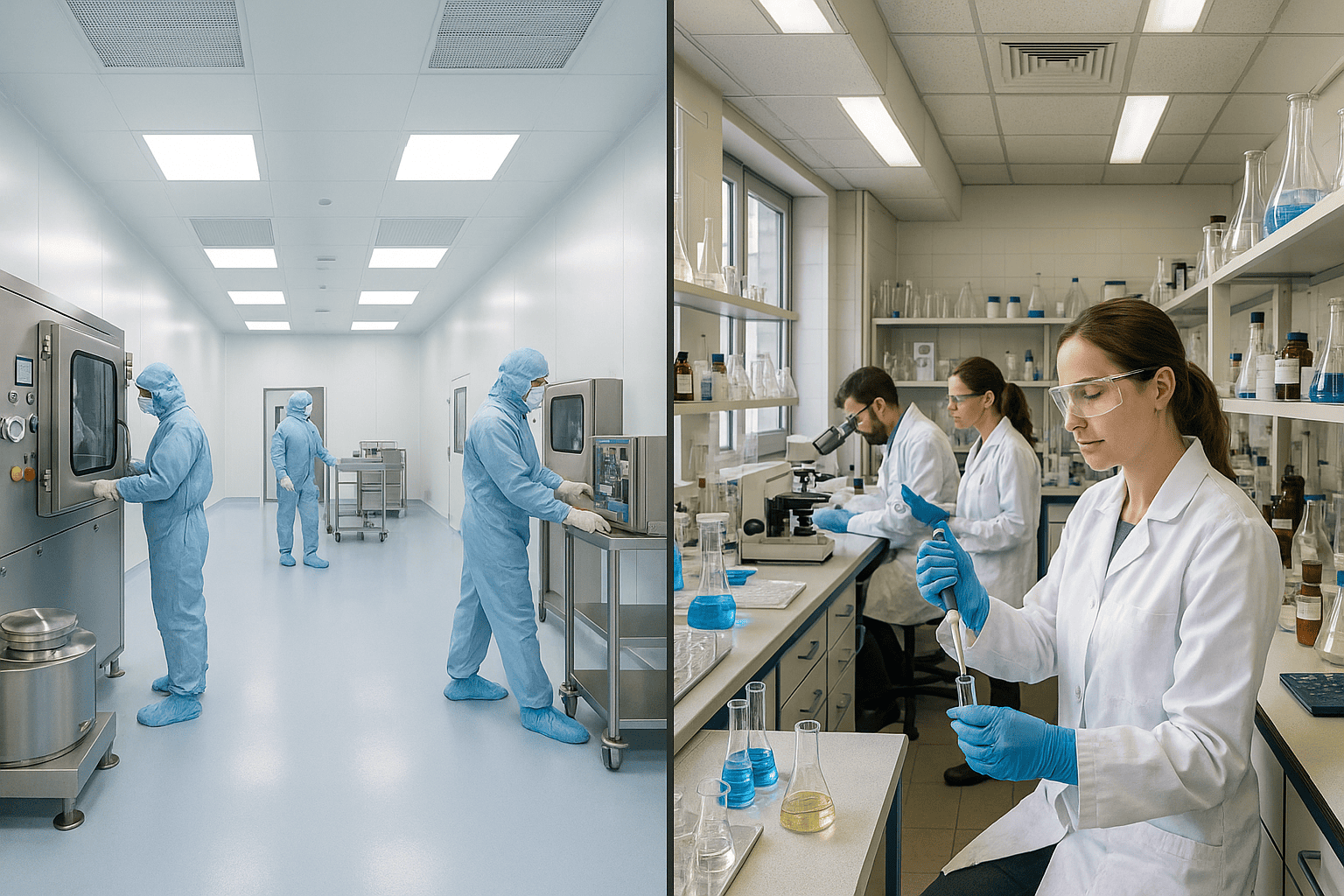
When people hear the words “cleanroom” and “laboratory,” they often think they are the same thing. Both are used for science and technical work, and both can look similar from the outside. However, they are not identical. A cleanroom has much stricter control of dust, particles, and sometimes microbes than a normal laboratory.
What Is a Laboratory?
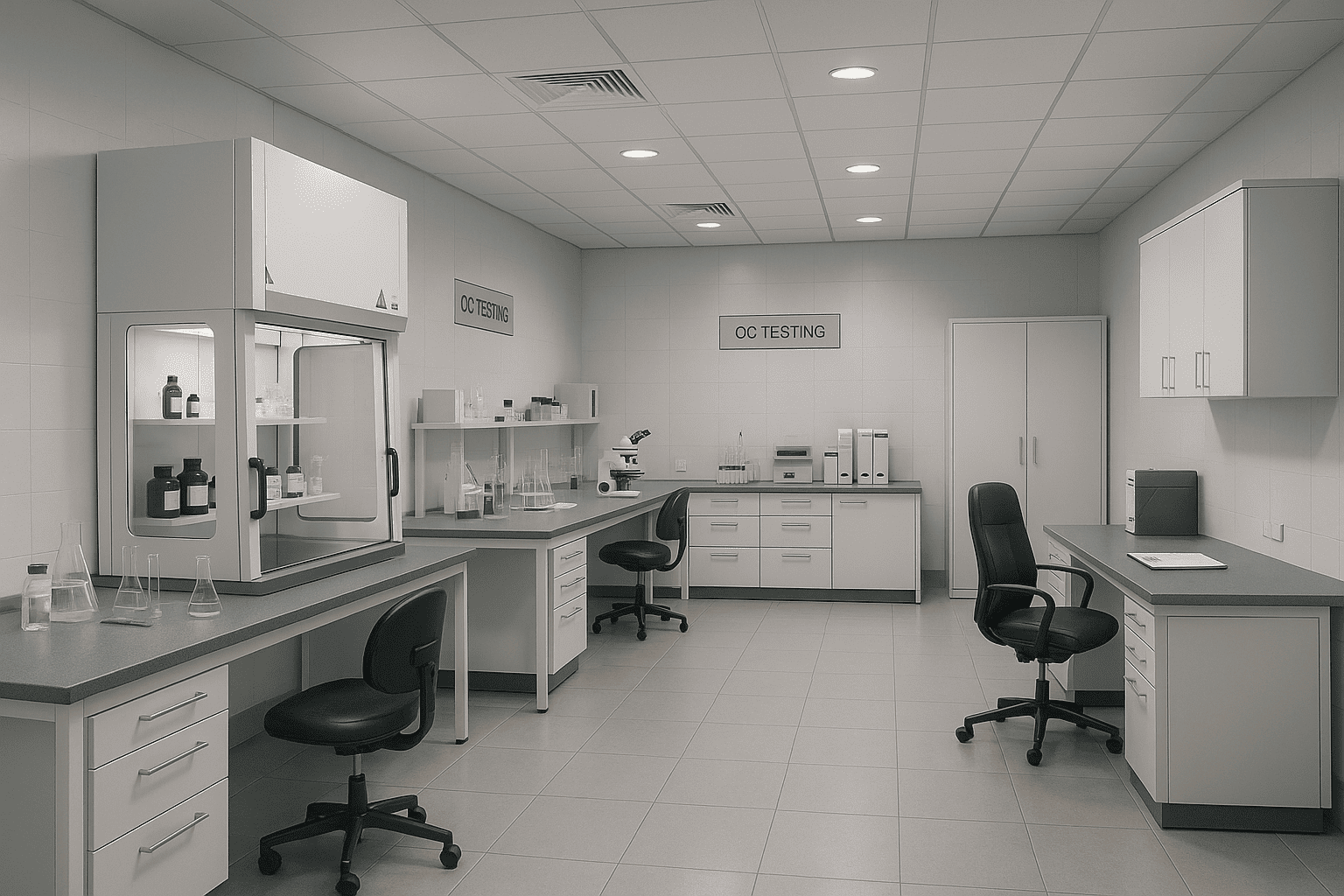
A laboratory (lab) is a room or building where scientific experiments, tests, or research are done. Labs can be found in schools, hospitals, research centers, and factories.
Typical features of a laboratory include:
-
- Workbenches and lab furniture
- Basic ventilation and sometimes fume hoods
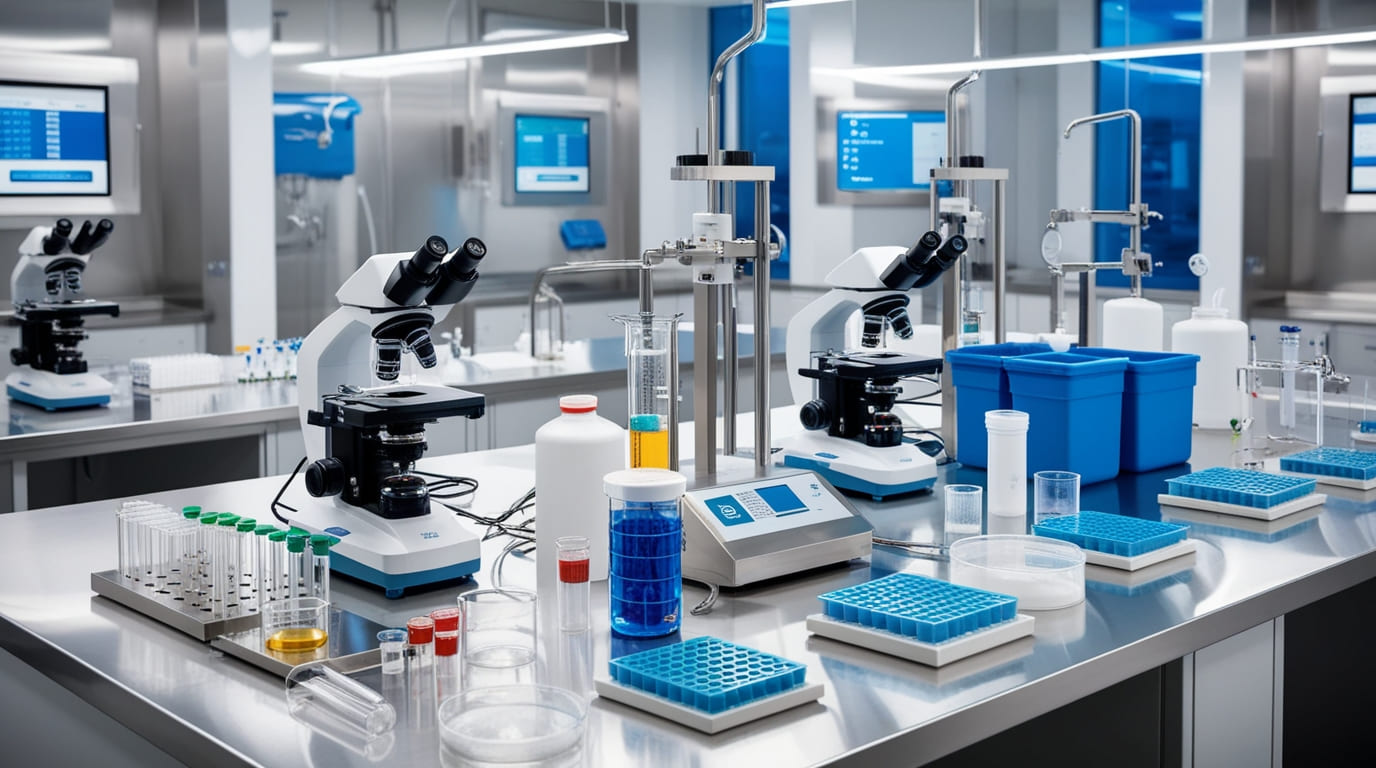
- Equipment like microscopes, balances, incubators, and analyzers
- Safety tools like eye wash stations, fire extinguishers, and PPE (gloves, goggles, lab coats)
In many labs, the focus is on:
-
- Safety of people
- Accurate testing and measurements
- Proper handling and storage of chemicals, samples, or biological materials
While some laboratories may have cleanliness rules, they do not always control airborne particles (like dust) and microbes as strictly as a cleanroom does. A normal lab may not have special air filtration or pressure control.
What Is a Cleanroom?
A cleanroom is a specially designed room where:
-
- The amount of dust and particles in the air is strictly controlled
- Air quality is monitored and kept within set limits
- Temperature and humidity may also be controlled
- People and materials enter through special procedures to avoid contamination
Key features of a cleanroom:
-
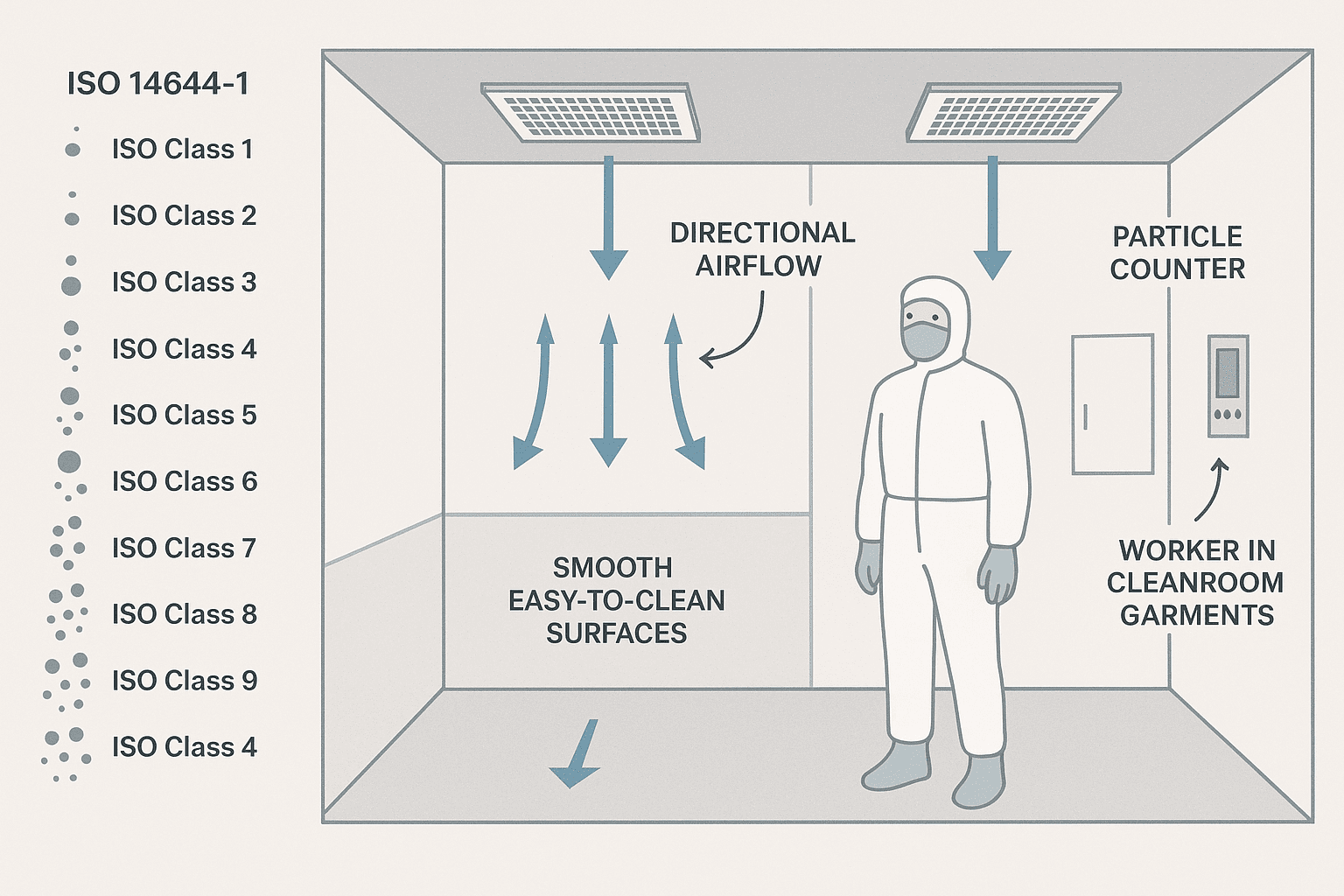
- HEPA or ULPA filters to remove particles from the air
- High air change rates (air is replaced many times per hour)
- Positive or negative air pressure, depending on the purpose
- Smooth, easy-to-clean surfaces (floors, walls, ceilings)
- Special clothing: coveralls, hairnets, masks, gloves, shoe covers
Cleanrooms are used in:
-
- Pharmaceuticals and biotechnology
- Medical device manufacturing
- Microelectronics and semiconductors
- Aerospace and optics
- Food and cosmetic industries (for critical processes)
Difference between cleanroom and laboratory
Here is a simple way to understand the Difference between cleanroom and laboratory:
- Level of cleanliness
-
-
- Laboratory: Usually focuses on basic cleanliness and good housekeeping. Dust and particles are not usually measured or strictly controlled.
- Cleanroom: The number of particles in the air is measured and kept below strict limits. There are official standards for how clean the air must be.
-
- Air control
-
-
- Laboratory: May have regular ventilation and sometimes fume hoods, but not special filtration for the entire room.
- Cleanroom: Uses HEPA/ULPA filters, controlled air flow, and specific air pressure (positive to keep contaminants out, or negative to keep hazardous materials in).
-
- Design and materials
-
-
- Laboratory: Built like a normal room, although with chemical-resistant benches and flooring.
- Cleanroom: Built with smooth, non-shedding, and easy-to-clean materials. Corners are often curved to make cleaning easier and to avoid dust build-up.
-
- Clothing and behavior
-
-
- Laboratory: Lab coat, regular shoes, sometimes gloves and goggles.
- Cleanroom: Special garments (gown, coverall, hood, mask, gloves, shoe covers). There are strict rules on movement, talking, and what can be brought inside.
-
- Purpose
-
-
- Laboratory: Focus on experiments, testing, and research. Cleanliness is important, but not always the main goal.
- Cleanroom: The main goal is to prevent contamination of products or processes. It is part of the production or critical testing environment.
-
- Regulation and standards
-
-
- Laboratory: May follow safety standards (like chemical safety or biosafety levels), but not always particle-count standards.
- Cleanroom: Must meet formal standards such as ISO cleanroom classes or regulatory guidelines, especially in pharmaceuticals and medical devices.
-
In short, all cleanrooms are controlled technical spaces, but not all laboratories are cleanrooms.
Pharmaceutical clean room classification
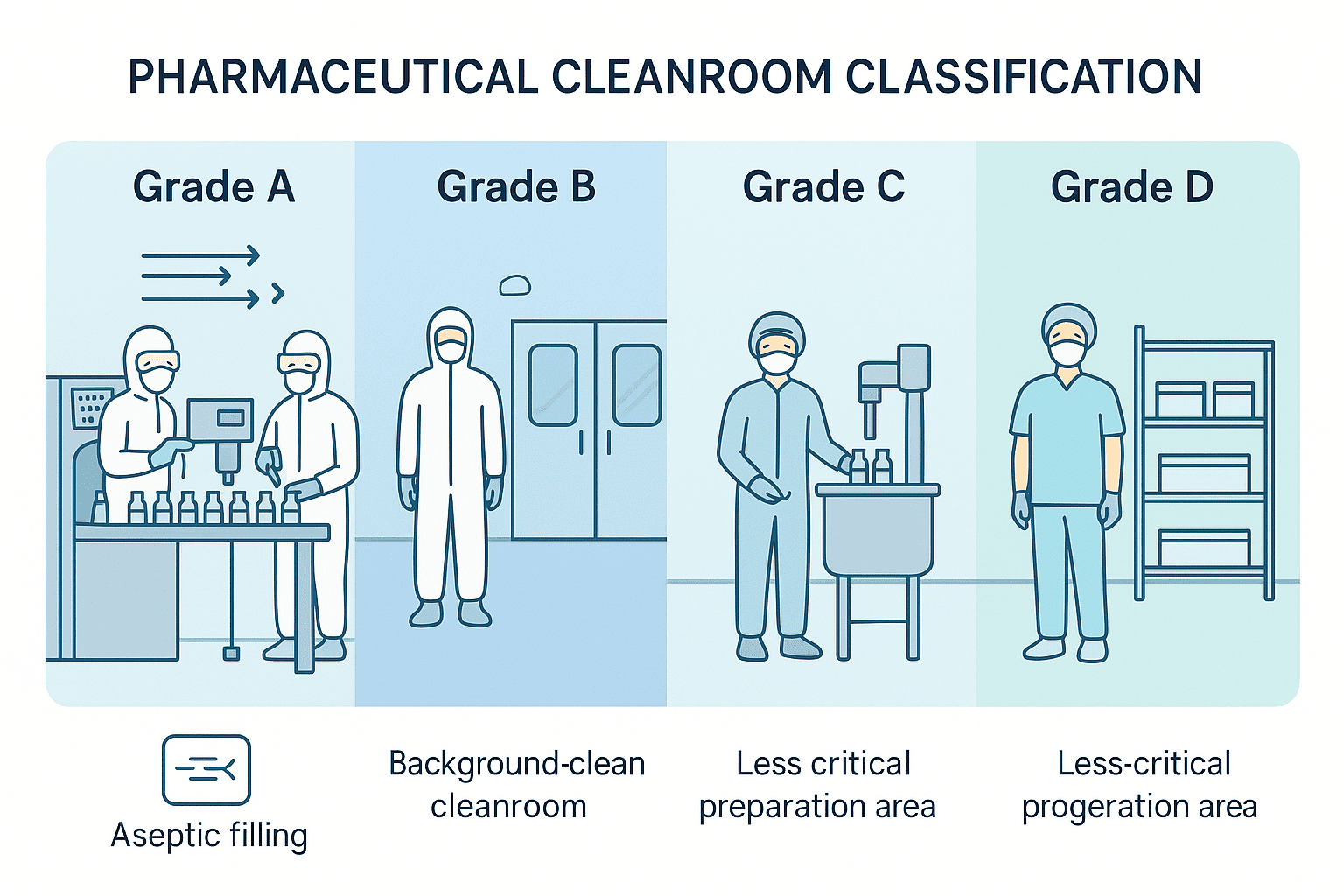
In the pharmaceutical industry, cleanrooms are essential to make safe medicines, especially sterile products like injections, eye drops, and some creams. To control contamination, regulators use Pharmaceutical clean room classification systems.
One widely used system is the EU GMP (Good Manufacturing Practice) classification, which divides clean areas into Grades A, B, C, and D:
-
- Grade A
- The cleanest zone.
- Used for high-risk operations like filling of sterile products, open vial handling, and aseptic connections.
- Often provided by laminar airflow units (workstations) within a cleaner background area.
- Grade B
- Background environment for Grade A operations (for example, the room around an aseptic filling line).
- Very low particle and microbial counts allowed.
- Grade C
- Clean area for less critical stages of sterile product manufacturing, such as solution preparation or filtration steps before final sterilization or aseptic filling.
- Grade D
- Basic clean area for less critical stages, like handling of components after washing or early steps in solution preparation.
- Grade A
These grades specify limits for:
-
- Maximum number of particles in the air
- Microbial contamination (number of colonies allowed)
- Conditions in “at rest” (no production) and “in operation” (during production)
Following Pharmaceutical clean room classification helps companies prove that their medicines are made in a controlled, safe environment that protects patients from contamination.
ISO cleanroom Classification
Another major system used around the world is the ISO cleanroom classification from ISO 14644-1. ISO stands for the International Organization for Standardization.
This system defines cleanrooms by “ISO Classes” based on the maximum number of particles per cubic meter of air. The classes range from ISO Class 1 (extremely clean) to ISO Class 9 (least clean in the standard).
-
- ISO Class 1–3
- Ultra-clean environments, used in very sensitive electronics, nanotechnology, and some advanced optics.
- Almost particle-free; very strict controls.
- ISO Class 4–5
- Common in semiconductor and microelectronics manufacturing.
- Also used in pharmaceutical operations that require low particle counts.
- ISO Class 6–7
- Frequently used for many clean manufacturing operations in pharma, biotech, and medical devices.
- ISO Class 8–9
- Used for less critical clean areas, gowning areas, or controlled but not highly critical spaces.
- ISO Class 1–3
A ISO cleanroom is tested by counting the number of particles of specific sizes (for example, 0.5 micrometers and 5 micrometers) in a fixed volume of air, and checking if these counts are below the allowed limits for a given ISO class.
In pharmaceuticals, companies often have to meet both:
-
- An ISO class (for particle control)
- A GMP grade (for both particle and microbial control)
For example, a Grade B area might correspond roughly to ISO Class 5 “at rest,” although the systems are not exactly the same and must be matched carefully by experts.
Why Understanding These Differences Matters
Knowing the Difference between cleanroom and laboratory is important if you:
-
- Work in pharmaceuticals, biotech, medical devices, or electronics
- Are planning or validating a production or testing space
- Need to comply with regulations and quality standards
Using the right environment helps:
-
- Protect products from contamination
- Protect patients and end-users
- Meet regulatory requirements and pass inspections
- Reduce batch failures and costly recalls
A normal laboratory may be enough for basic research or routine testing. But when products must be sterile or extremely clean, a properly designed and classified cleanroom is essential.
Conclusion
A laboratory is a space for scientific work, often focused on safety and accurate results. A cleanroom is a highly controlled environment designed to strictly limit particles and microbes, especially important in industries like pharmaceuticals, electronics, and medical devices.
By understanding the Difference between cleanroom and laboratory, and knowing how Pharmaceutical clean room classification and ISO cleanroom standards work, organizations can choose the right level of control, design better facilities, and ensure the quality and safety of their products.
Leave a Reply